Memo: Salesforce Didn't Bet on a Model. It Absorbed the Choice.
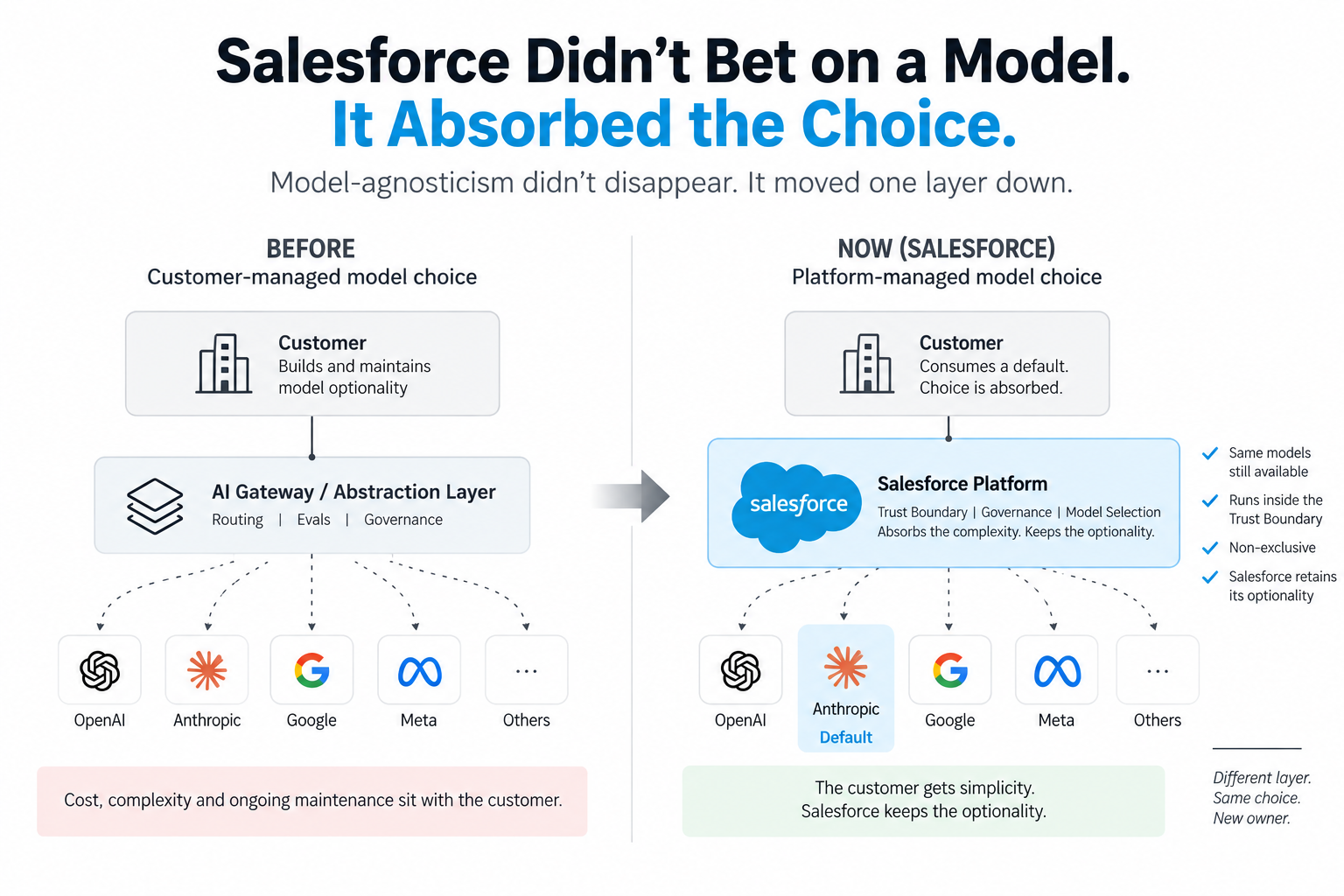
On 26 August, Salesforce made Claude the default reasoning model across Agentforce, Slack, and its own engineering org, and the first LLM to run inside its Trust Boundary. Every outlet read it as Anthropic winning the enterprise. That is the wrong scoreboard. Read the structure instead: the deal is non-exclusive, Claude remains selectable in Agent Builder, and Salesforce still works with other providers. Salesforce did not surrender model choice – it kept the choice for itself and removed the need for customers to exercise theirs. Model-agnosticism just stopped being a customer competency and became a platform feature, held by a party whose interests are not identical to yours.
The announcement is dense enough that most coverage flattened it. What Salesforce and Anthropic actually shipped on 26 August, during Salesforce's Q2 FY27 earnings call, was three things pointing in different directions.
Salesforce went into Claude: a plugin with 37 prebuilt sales skills, letting a seller run pipeline reviews and governed CRM actions from inside Claude's own interface. Claude went into Salesforce: the reasoning model for the Atlas Reasoning Engine, the default powering Agentforce Vibes and Agentforce Coworker, and – this is the part the coverage dropped – available in Agent Builder, meaning selectable rather than mandated. And Claude went into Slack as the default model for Slack AI and Slackbot. Underneath all of it, Claude runs inside the Salesforce Trust Boundary via Amazon Bedrock, with CrowdStrike and RBC Wealth Management named as early adopters.
The financial architecture matters more than the product surface. Benioff has said Salesforce is on track to spend roughly $300 million on Anthropic tokens in 2026 – a figure he gave on a podcast in May, mostly attributed to internal software coding, and never confirmed in either company's official disclosures. Separately, Salesforce has invested more than $300 million in Anthropic since the Series C in early 2023, holding roughly 1% of a company valued at $380 billion after its February Series G. That stake is now reportedly worth around $5 billion, and Salesforce's Q2 net income included a $2.6 billion investment gain tied partly to it.
So the honest summary is not "Salesforce bet the company on Claude." It is: Salesforce made Claude the default, kept every alternative live, and holds a position in its own default supplier that returned more in one quarter than a decade of licence revenue from a mid-size customer.
The advice everyone gave, and what it actually costs
For eighteen months the enterprise AI commentariat has said one thing in one voice. Model-agnostic architecture is no longer optional. Vendor lock-in is the blind spot CIOs are missing. An AI gateway with model portability can cut costs 30 to 85 percent. The explainers are interchangeable.
The argument was made by events, not consultants. On 12 June, Commerce Department export controls forced Anthropic to suspend Claude Fable 5 and Mythos 5 globally – not regionally, not for foreign users only, but entirely, because the order covered foreign nationals inside the United States including Anthropic's own staff. Shops with a routing layer rerouted. Shops without one waited until Commerce lifted the controls on 30 June and access was restored on 1 July. Nineteen days. That is the cleanest available demonstration of the agnostic thesis: your model can vanish for reasons that have nothing to do with the model.
What the advice never priced is what agnosticism costs the person practising it. To be genuinely model-agnostic you maintain an abstraction layer, a gateway, and evals across every model you might route to – re-run every time any of them ships a point release, against a market that produced roughly a dozen new models from seven providers in the first seventeen days of August alone. You maintain prompts tuned to one model's quirks regardless of how portable you claim to be, because prompt behaviour does not transfer cleanly. You own the governance story: which model saw which data, and whether a silent swap underneath your workload just turned a validated system into an unvalidated one.
Agnosticism is not free optionality sitting quietly until needed. It is a standing internal function with headcount and a maintenance schedule that scales with the release cadence of the entire industry. The 30-to-85-percent savings the gateway vendors advertise are gross, not net – they never subtract the team required to keep the gateway honest.
Salesforce looked at that tax and offered to pay it.
The absorption, and the part nobody noticed
Read the arrangement as an operating model. Claude sits inside the Trust Boundary, so the customer's data-residency and compliance story lives inside Salesforce's envelope rather than inside a routing layer the customer builds and defends to an auditor. Amodei told CNBC that permission management was a central design focus, and the two companies jointly built what they call Enterprise Frontier Safeguards. The default designation means the model-selection decision no longer appears on the customer's surface for most workflows. The equity position means Salesforce captures upside on the supplier it depends on.
That is a platform insourcing a function every customer was previously performing badly and redundantly. The customer still gets the outcome agnosticism promised – not having to care which model, not rebuilding when the leaderboard turns.
But here is what the "Anthropic won" reading and the "Salesforce bet everything" reading both miss, and it is the whole story.
Salesforce kept its own optionality. The partnership carries no exclusivity. Salesforce continues to work with other model providers. Claude is a reasoning model in Atlas, not the only one, and remains selectable in Agent Builder. And the Trust Boundary implementation runs through Amazon Bedrock – a deliberately multi-model platform. The abstraction layer did not disappear. It moved one level down and changed owner.
So the trade is not customer choice for customer safety. It is customer choice for platform choice. Salesforce now holds the routing decision, the switching capability, and the supplier relationship, while the customer holds a default they did not select, cannot easily audit, and will not be consulted about when it changes. The buyer is not more locked in than before. The buyer is differently locked in – trading model lock-in, which was visible and hedgeable, for platform lock-in, which is neither.
And the party now holding your model decision has a financial position in the answer. A roughly $5 billion stake generating a $2.6 billion quarterly gain is not a rounding error in Salesforce's decision calculus. This is not an accusation of bad faith; the model is genuinely strong and the integration is genuinely deep. It is an observation about structure: when your platform selects your model, and your platform owns 1% of the model provider, the selection criteria are no longer purely technical, and you have no visibility into the weighting.
What this actually answers about the SaaSpocalypse
Benioff was explicit about the framing on the call: "This nonsense of the SaaSpocalypse, I think it's time for it to stop." The thesis he was rebutting is that agents dissolve application software – if the agent does the work, why pay for the interface the human used to click through?
Claudeforce is a more convincing counter-argument than anything said out loud. SaaS does not survive the agent era by having a better interface. It survives by becoming three things a raw model cannot be alone: the entity that owns the governance boundary the model may not cross; the entity that turns variable inference into predictable pricing; and the entity that absorbs model selection and model churn so the customer's roadmap stops shaking every time a provider ships. None of those is an interface. All are the platform monetising a burden.
Which is why "Anthropic won the enterprise" is the wrong scoreboard. In this structure Anthropic supplies a component that Salesforce wraps in a trust boundary, bills as part of a seat, holds equity in, and can substitute. Anthropic also became a Salesforce customer – it uses Salesforce as its preferred CRM and Slack for internal collaboration. The margin is in being the layer that makes the model safe, predictable, and invisible.
The numbers underneath support the read. Agentforce and Data 360 ARR approached $3.9 billion in the quarter, more than tripling year over year, and the stock rose 12 to 14 percent after hours. The market did not price a model win. It priced a platform that had found something to sell in the agent era.
What operators should do
Price platform lock-in the way you were taught to price model lock-in. Your agnostic gateway was never a moat; it was a cost of doing business you were told to be proud of. The platforms are offering to run it. The real question is no longer which model but whose absorption layer – and that decision is stickier, less visible, and harder to reverse than any model choice.
Do not confuse absorbed choice with absorbed risk. These are different, and the distinction is where the money is. Salesforce has taken the selection burden off your desk. It has not contractually assumed your outage exposure. If a Fable 5-style event hits the default model, your workflows stop, and the fact that Salesforce chose the model does not mean Salesforce owes you a remedy. Get the failover terms in writing. Ask specifically: what is the substitution procedure, what notice do I get, and what happens to my validated workload when the default changes.
Treat "default" as a governance event. Default implies changeable. When the model sits inside the platform's trust boundary, you have lost the seam where you used to run conformity assessment, and the swap-risk problem does not disappear – it moves inside someone else's envelope where you can see it less. Contract for the change now.
Use the optionality you still have. Claude is selectable, not mandatory. Agent Builder still exposes the choice, the deal is non-exclusive, and Salesforce still works with other providers. Anyone in a regulated posture or running workloads that cannot tolerate a supplier interruption should be exercising that selectability deliberately rather than accepting the default by inertia. The default is a convenience, not a constraint – and treating it as a constraint is how a convenience becomes one.
Bottom line
The story is not that a model won. It is that model-agnosticism migrated from a customer competency to a platform feature, and the platform that now performs it has an equity position in the answer. Salesforce absorbed a tax its customers were paying badly, and in the same motion acquired a decision right its customers used to hold – while keeping, for itself, every option it removed from their daily view.
The forward call: watch who copies the structure, not who copies the model. The thing to track over the next two quarters is whether SAP, ServiceNow, Workday, and Microsoft replicate the shape – a default model, the token relationship on the platform's book, an equity position in the supplier, and the model running inside the platform's trust boundary. If two of them do, model-agnosticism as a customer strategy is finished across the enterprise stack, and the only genuinely agnostic parties left will be the platforms, playing their suppliers against one another while their customers hold none of that leverage.
The interface was never the point. The absorption layer is the product now, and the question worth asking your vendor is not which model they chose. It is what they own on the other side of the choice.
Sources: Claudeforce announcement details – the 37-skill Salesforce in Claude plugin, Claude as default model for Slack AI, Slackbot, Headless 360, Agentforce Coworker and Salesforce's engineering org, Claude as a reasoning model for the Atlas Reasoning Engine and available in Agent Builder, and Claude as the first LLM fully integrated in the Salesforce Trust Boundary via Amazon Bedrock – per Salesforce's press release and investor release, 26–27 August 2026. Pilot availability, September 2026 open beta, and late-2026 skill expansion per the same. Early adopters CrowdStrike and RBC Wealth Management per Cloudsheer. Non-exclusivity and Salesforce's continued work with other model providers per WebProNews. Benioff's SaaSpocalypse remark and the earnings-call context per SalesforceBen. The ~$300 million 2026 Anthropic token projection originates from Benioff's remarks on the All-In podcast (May 2026), attributed mostly to internal software coding; The Next Web notes neither company has confirmed the figure in official disclosures. Equity position – more than $300 million invested since the early-2023 Series C, roughly 1% of Anthropic, valued at approximately $5 billion per Bloomberg as cited by The Next Web, with Anthropic valued at $380 billion after its February 2026 Series G – and the $2.6 billion Q2 investment gain per Yahoo Finance's Claudeforce coverage. Amodei's permission-management comments and Enterprise Frontier Safeguards per CNBC as reported. Agentforce and Data 360 ARR of ~$3.9 billion and the 12–14% after-hours move per WebProNews and Yahoo Finance. Claude Fable 5 and Mythos 5 suspension of 12 June 2026, the scope covering foreign nationals inside the US, and restoration on 1 July after controls were lifted 30 June, per Anthropic's statement and contemporaneous reporting. August model-release cadence compiled from provider announcements via LLM Gateway. Cross-references to prior Signal Memo coverage: substrate vs. broker, silent substitution, defeat devices for benchmarks. What is original to this memo: the reading of Claudeforce as platform absorption of the agnosticism function rather than a model win, the observation that Salesforce retained the optionality it removed from customer view, the equity-conflict point, and the structural forward call.