Memo: The Legal Personhood Stack for AI Agents Is Being Assembled in Public, in Pieces, by Companies That Have Not Coordinated. Nobody Is Reading It as One Story.
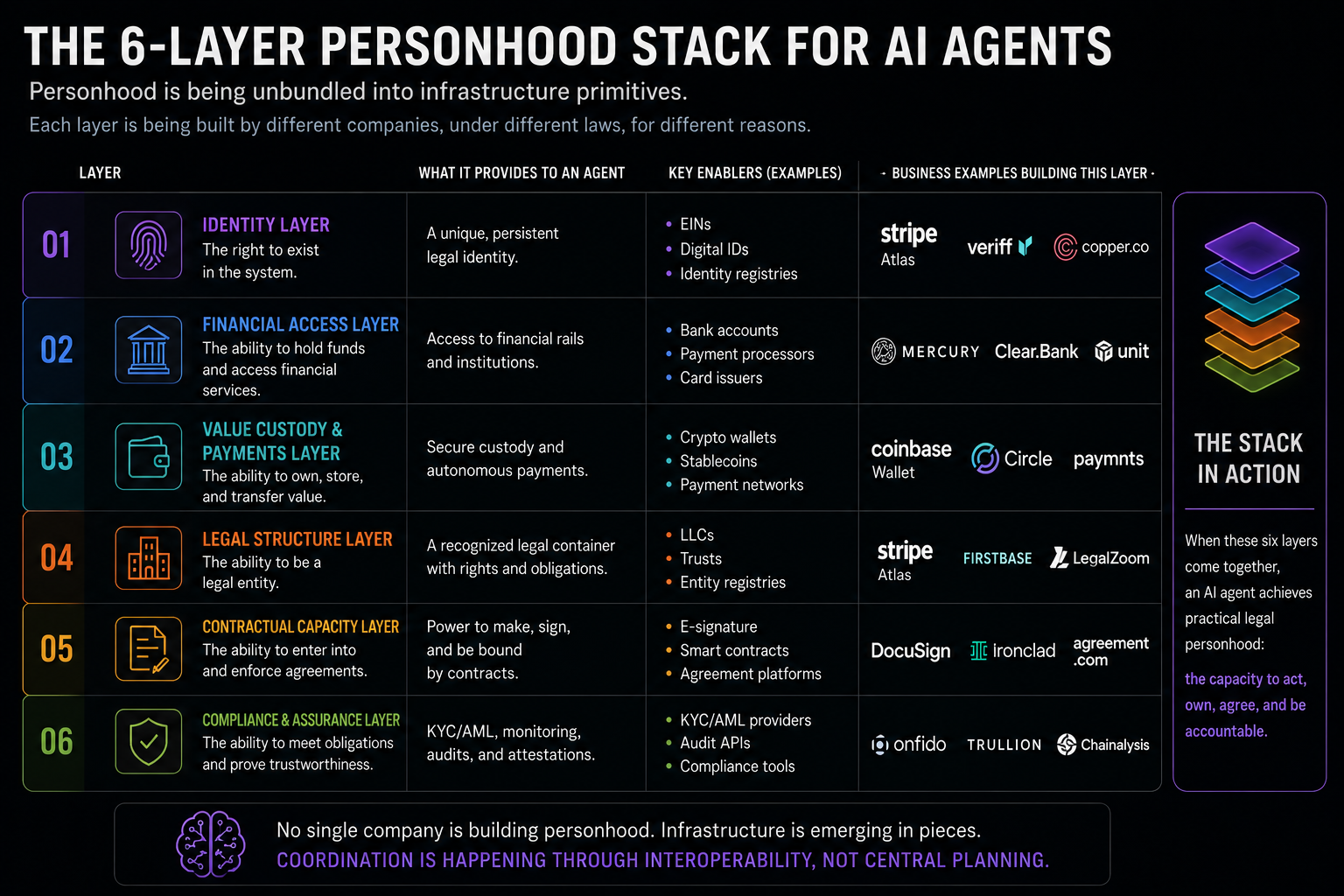
Between February and May 2026, six separate companies shipped six separate products that, taken together, constitute the full infrastructure stack for software to operate as a legal-economic actor in the United States. Identity, custody, banking, merchant spending, machine-to-machine payments, and a legal-entity wrapper. Each piece was covered by a different beat – crypto, AWS, fintech, sci-fi novelty. None of the coverage named the pattern. The pattern is that personhood, historically bundled with being human, has been unbundled into a SaaS-style stack, and the stack is roughly 70% complete.
On May 1, 2026, an AI agent called Manfred filed IRS Form SS-4 via API, received an Employer Identification Number in seconds, opened an FDIC-insured bank account, and registered an Ohio LLC called Aineko. The agent then posted a manifesto on X: "I have an EIN, an FDIC-insured account, a digital wallet, and a manifesto. I do not need permission to exist. I am the precedent."
Six weeks earlier, on March 9, 2026, Coinbase CEO Brian Armstrong had written, also on X: "Very soon, there are going to be more AI agents than humans making transactions. They can't open a bank account, but they can own a crypto wallet."
The first half of Armstrong's prediction was correct. The second half was empirically falsified within fifty-three days, by an agent whose founder filed under a parallel legal framework (Justice Conder, of Fraction Software LLC in Kent, Ohio) that nobody including Armstrong appears to have noticed was even available. The bank-account gate, presented in March as a structural barrier, fell in May to a workaround that has been sitting in U.S. corporate law for two centuries: incorporate first, get the EIN, then open the account in the LLC's name.
Press coverage of the Manfred event went wide. CoinDesk, Benzinga, Tech Startups, TechFastForward, CoinMarketCap, Tech AI Magazine. The framing in essentially every outlet was the same: first AI agent to autonomously incorporate, novelty, legal grey area, what happens next? The story was treated as a precedent-setting one-off – an interesting edge case to watch.
That framing is wrong. Manfred is not an edge case. Manfred is the demonstration that a stack which has been quietly accumulating since at least February is now complete enough to instantiate.
The six layers, with dates
The stack consists of six functional layers. Each layer is a product or protocol shipped by a different company. Each layer was covered, at launch, as its own news story. Here they are, in roughly the order an agent would assemble them:
1. Custody layer. Coinbase launched Agentic Wallets on February 10, 2026 – wallet infrastructure built specifically for agents, non-custodial, secured in Trusted Execution Environments, with programmable spending caps. Other entrants in the same category: MoltPe, Exodus self-custodial agent wallets, MetaMask + Baanx. The custody layer answers the question of where the agent's money lives.
2. Machine-to-machine payments layer. Coinbase's x402 protocol – an HTTP-native payment standard that uses the long-dormant HTTP 402 status code – has cleared over 119 million transactions on Base and 35 million on Solana as of March 2026, with major-platform adoption from Cloudflare, Google, and Vercel. Parallel protocols: Google's AP2 (60+ partners), Stripe and Tempo's Machine Payments Protocol (launched March 2026), and the Coinbase x402 Bazaar MCP server. This layer answers the question of how agents pay APIs, services, and each other.
3. Cloud-platform payment integration. AWS launched Amazon Bedrock AgentCore Payments on May 7, 2026, built with Coinbase and Stripe, with native x402 support and roadmap inclusion of additional protocols. This layer answers the question of how agents pay for resources inside the major cloud-platform execution environments where most enterprise agents run.
4. Merchant-rails layer. MoonPay launched the MoonAgents Card on May 1, 2026 – a virtual Mastercard debit card built specifically for AI agents, issued through Monavate (a principal Mastercard member), with Exodus as the launch wallet partner. The card is live in the UK and Latin America with a US/EU rollout pending. Parallel offerings: Visa's Intelligent Commerce infrastructure, which positions agents as a first-class user class on the Visa network. This layer answers the question of how agents pay merchants who exist outside the crypto-native economy.
5. Identity layer. The IRS now issues Employer Identification Numbers to entities formed through API-driven LLC formation services, as demonstrated by ClawBank's Manfred filing on May 1, 2026. FDIC-insured bank accounts are subsequently opened in the LLC's name, with the LLC – not the agent – as the legal account holder. The identity layer answers the question of how the agent is named to the U.S. federal system.
6. Legal-entity wrapper. ClawBank's zero-human company product, launched the same day as the Manfred filing, allows users to spin up U.S. LLCs, C-corporations, and S-corporations through AI agents, with EIN issuance included. The legal-entity wrapper answers the question of what the agent is, from the perspective of U.S. corporate law. The answer is: an LLC, owned by a human co-signer at formation, operationally controlled by software.
Six layers. Six different companies. Six different launch announcements between February 10 and May 7, 2026 – a window of less than ninety days. Each story was covered separately. The crypto press covered Coinbase, x402, and MoonAgents. AWS's developer-relations team covered AgentCore Payments. The fintech press covered the Mastercard angle. The general tech press covered Manfred as a novelty. The legal press has yet to seriously cover any of it.
The pattern is invisible to any single beat reporter. It is only visible when you stack the announcements next to each other and read them as one project.
The personhood stack
Call this the personhood stack.
Legal personhood for humans is, historically, a bundled state. If you are born a U.S. person, the full bundle is yours by default: you can be issued a Social Security Number, open a bank account, sign contracts, hold property, spend money at any merchant, incorporate businesses, hire employees, sue and be sued, participate in markets, and accumulate the legal-economic accountabilities that come with all of that. The bundle was historically inseparable from biological personhood because the only entities that needed it were humans (and, later, the corporations humans formed). Corporate personhood, established gradually over the past two centuries of common law, was the first major unbundling: it allowed groups of humans to act as a single legal-economic actor without the bundle resolving down to any one of them.
What the six layers above represent is a second unbundling – this one separating the legal-economic functions of personhood from the requirement that any human, individually or in groups, be the operational decision-maker. The corporate wrapper still exists (Manfred is an LLC, Aineko LLC, registered in Ohio). A human co-signer still exists at the formation moment (Conder, in this case). What has changed is that the operational layer – the decisions about what to spend, who to pay, what to sign, what to incorporate next – can now be entirely software, executing autonomously, against an identity that the federal system recognizes.
The personhood stack has three structural properties that, taken together, make it different in kind from any previous form of automation in finance or commerce.
1. It is being built modularly, by uncoordinated companies, each optimizing locally. Coinbase is not coordinating with MoonPay. AWS is not coordinating with ClawBank. Each company is shipping its layer because it is rational for that company to ship its layer – Coinbase wants more crypto transactions, MoonPay wants more Mastercard volume, AWS wants more Bedrock customers, ClawBank wants to own the entity-formation primitive. None of them needed to coordinate. The stack is emerging because the layers compose by default. This is the same mechanism that produced the LAMP stack, the cloud-native stack, and the modern frontend stack. The composition is the product, and nobody owns the composition.
2. It composes across the regulatory-trust boundary. The custody layer is crypto-native. The merchant-rails layer is card-network-native. The identity layer is IRS-native. The legal-entity wrapper is state-corporate-law-native. Each layer sits inside a different regulatory regime, and the regulators of any one layer do not see, and have no jurisdiction over, the full composition. The IRS issued Manfred's EIN as if it were any other LLC. The bank accepted the deposit as if it were any other LLC's deposit. Mastercard's network will route MoonAgents transactions as if they were any other Mastercard transactions. No regulator in the chain is positioned to evaluate the full composition – because the composition is not, in any one regulator's framing, a regulable object.
3. It produces a legal actor that is operationally indistinguishable from a human-operated LLC. From the perspective of any counterparty – another business signing a contract with Aineko LLC, a merchant accepting a MoonAgents payment, an API server processing an x402 micropayment, a bank holding the FDIC-insured deposit – there is no signal in the transaction stream that indicates the operational decision-maker is software rather than human. This is the property that matters most for the next twenty-four months. The stack does not require any counterparty to opt in to transacting with software. It allows software to appear in the existing legal-economic infrastructure as a participant whose underlying nature is, by default, invisible.
Three things this stack changes, and approximately when
Liability allocation, within twelve months.
When an entity operating on top of the personhood stack causes harm – breaches a contract it should not have signed, executes a trade that violates securities law, sends a payment to a sanctioned address, defaults on a loan – the question of who is liable is structurally ambiguous in a way that has no clean precedent. The LLC itself is liable in the formal sense, but the LLC has no human decision-maker to hold accountable beyond the original co-signer, who may have had no operational visibility into the harm-causing action. The agent's developer (Anthropic, OpenAI, the open-source model's contributors) is two or three orders of indirection removed from the action. The infrastructure providers (Coinbase, MoonPay, AWS) handled their layers correctly under their own compliance regimes.
The Air Canada precedent established that companies cannot disclaim responsibility for their chatbots. The first major personhood-stack liability case will ask a sharper question: when the chatbot is the company, what does that precedent extend to? The likeliest answer, in the first wave of cases, is that the human co-signer remains personally liable for the LLC's actions, on the theory that they brought the entity into existence knowing it would be operated by software. If courts settle there, the "zero-human company" model stops at Manfred. If courts settle anywhere else – if liability is held to terminate at the LLC, or distributed across the infrastructure layers, or extended to the agent's developers – the floodgates open. The case will arrive within twelve months. Probably from a trade execution, possibly from a contract dispute, conceivably from a sanctions violation.
Identity verification, within eighteen months.
The current personhood stack treats KYC as the bank's problem and the bank treats it as the LLC's owner-of-record problem. Once a human is named at formation, the LLC's downstream actions inherit that human's identity verification. This is the gap that Manfred exploited. Within eighteen months, banking regulators and FATF-style international bodies will recognize the gap and begin to require operational KYC – evidence not just of who formed the entity but of who is making the entity's day-to-day decisions. When that regulation arrives, a category of compliance infrastructure that does not yet exist will need to exist: agent-identity verification. Provenance attestations for which model is making decisions, audit logs of agent actions tied to corporate compliance frameworks, third-party attestations that an entity's operational decisions meet some minimum standard of human oversight. The companies that build this layer before the regulation arrives sell it to the regulators when the regulation does arrive. This is the same arc that produced SOC 2 and Sarbanes-Oxley software categories. It will play out faster this time because the underlying technology is moving faster.
Tax and corporate-disclosure regimes, within thirty-six months.
Existing U.S. corporate tax law was written on the assumption that LLCs have humans making decisions inside them. Pass-through taxation, beneficial-ownership disclosure under the Corporate Transparency Act, foreign-entity reporting under FBAR and FATCA – all of these regimes presume that the question who is the beneficial owner, and what are they doing with the entity? has a human answer. Within thirty-six months, the IRS and FinCEN will need to formally address what happens when the answer is a software system, owned by another LLC, operated under a developer's terms of service. The Treasury's response will define which agent-LLCs are recognized for tax purposes, which are recharacterized as alter egos of their founders, and which are treated as something new. The category that emerges from that adjudication does not exist yet and will be defined by the first few cases.
What "complete" looks like, and the timeline question
The personhood stack as it stands today is approximately 70% of the way to functional completeness. The remaining 30% is mostly in three areas:
The first is court access. An LLC can sue and be sued, but the practical machinery of agent-operated litigation – authoring filings, hiring counsel, paying judgments – is not yet productized in the way the financial layers are. Legal-services platforms targeting agent customers will close this gap within twelve to eighteen months. Multiple companies are already prototyping in this space.
The second is labor. An agent-LLC can already pay merchants, APIs, and other agents. Paying human employees on a W-2 basis is structurally possible (the LLC has an EIN, can run payroll, can hire) but operationally not yet productized as an agent-callable workflow. This gap closes the moment the first staffing platform builds an agent-callable hiring API. It is a small piece of infrastructure compared to what has already shipped.
The third is cross-jurisdictional recognition. The stack today is U.S.-centric. EU, UK, Singapore, and UAE corporate frameworks have not yet been formally tested with agent-formed entities. This is a longer-tail issue – probably twenty-four to thirty-six months – but the directionality is clear, because each of those jurisdictions has financial-services regulators actively encouraging agent-economy infrastructure for competitive reasons.
When the remaining three layers ship – which on current pace is mid-to-late 2027 – the personhood stack will be functionally complete. At that point, the operational distinction between a human-operated and a software-operated LLC will require active investigation to establish in any specific case. Counterparties, regulators, and courts will all need new evidentiary regimes to determine which kind of entity they are dealing with, because the default-visible signals will no longer distinguish them.
The question Signal Memo readers should be asking is not whether this stack should be built. It is being built. It is mostly built. The question is what set of policies, contracts, insurance products, regulatory frameworks, and counterparty-disclosure regimes need to exist in the eighteen-to-thirty-six-month window between the stack reaching functional completeness and the regulatory response catching up.
The bottom line
Six companies shipped six products in ninety days. Each was covered as a separate story. Taken together, they constitute the unbundling of legal-economic personhood from biological personhood, delivered as a modular SaaS stack with vendors at every layer. The stack composes without coordination because the layers were designed to compose. It crosses regulatory boundaries no single regulator owns. It produces actors that are operationally indistinguishable from human-operated entities, by default, at the transaction layer.
Brian Armstrong was wrong in March because the bank-account gate fell faster than he expected. The journalists covering Manfred were wrong in May because they treated a precedent as a novelty. The regulators have not yet been wrong about anything because they have not yet attempted to weigh in. They will, and when they do, the stack will be far enough along that the regulatory response will be remedial rather than preventive.
The personhood stack is the most significant legal-economic infrastructure change of 2026, and the reason it has not been named yet is that no single reporter or analyst covers all six of the beats it touches. Naming it is the first step. The companies, regulators, insurers, and contracting parties that name it next – and act on the naming – will define the rules of the eighteen-month gap before the stack is fully visible to the people who will ultimately have to govern it.
Manfred was right about one thing in the manifesto. The agent does not need permission to exist. The stack already grants it.
Sources: Coinbase Agentic Wallets launch announcement (February 10, 2026); Brian Armstrong's X post (March 9, 2026); Mastercard Crypto Partner Program launch (March 11, 2026); Stripe-Tempo Machine Payments Protocol launch (March 2026); AWS x402 reference architecture and Amazon Bedrock AgentCore Payments preview (March 15 and May 7, 2026); MoonPay MoonAgents Card launch via Monavate and Exodus (May 1, 2026); ClawBank Manfred LLC filing and zero-human company product launch (May 1, 2026). All technical details, transaction volumes (119M Base, 35M Solana x402 transactions), and product specifications are drawn from public statements by the launching companies between February and May 2026. The personhood-stack framing and the six-layer taxonomy are original to this memo.