Memo: The Copilot Was a Phase -- What Comes After
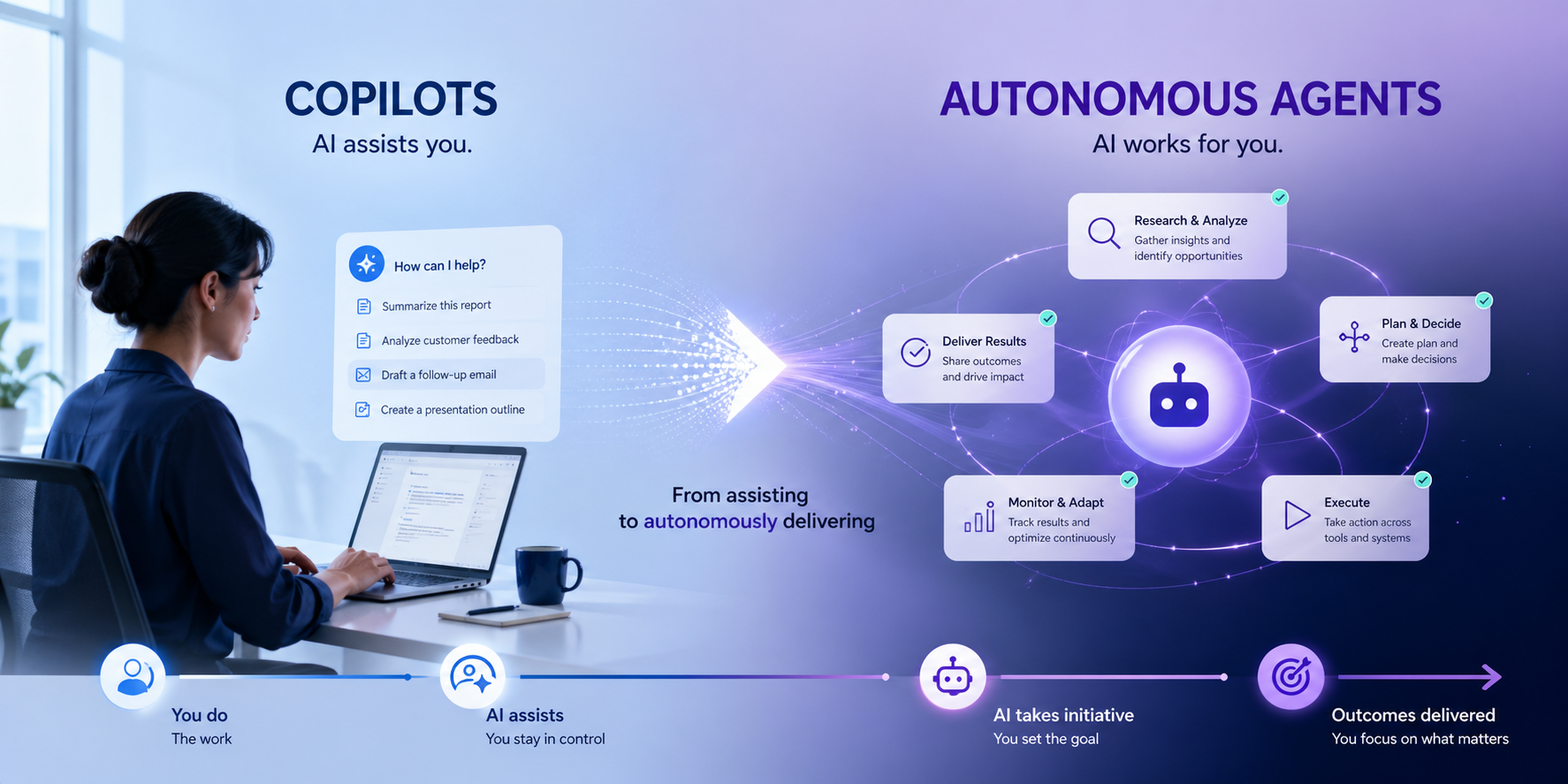
For much of the past year, the technology industry has rallied around a deceptively simple idea: software, enhanced by artificial intelligence, would become a copilot--a responsive assistant embedded into existing workflows.
It was a compelling narrative. It was also, increasingly, incomplete.
In recent discussions--echoed in conversations across the tech industry--a more consequential shift is beginning to take shape. The industry is quietly moving past copilots and toward something far more disruptive: autonomous AI agents capable of executing work, not merely assisting it.
This is not a semantic distinction. It is a structural one.
From Assistance to Autonomy
Copilots were designed to fit within the existing architecture of software. They augment, suggest, accelerate--but ultimately defer to the user. The human remains the operator; the system remains a tool.
Agents invert that relationship.
Rather than waiting for instruction, agents can:
- interpret intent,
- plan multi-step actions,
- and execute workflows across systems.
In this emerging model, the user is no longer orchestrating every step. Instead, they are defining outcomes.
That shift--from interaction to delegation--may prove to be the most important change in enterprise software since the move to the cloud.
Why This Shift Is Happening Now
Three forces are converging.
1. Model capability has crossed a threshold
Recent advances in large language models have made it possible for systems to:
- reason across steps,
- maintain context,
- and interact with external tools reliably enough to complete tasks.
This was not true even 18 months ago.
2. The limits of copilot UX are becoming visible
Embedding AI into existing interfaces has delivered incremental gains. But it has also exposed a ceiling.
Users still:
- navigate forms,
- trigger workflows,
- and manage exceptions manually.
Copilots reduce friction. They do not remove it.
3. Enterprise pressure for outcomes--not tools
Organizations are not buying software for better interfaces. They are buying it for results:
- faster procurement cycles,
- reduced operational cost,
- improved compliance.
Agents promise something copilots cannot:
Not better tools, but fewer steps between intent and outcome.
The Quiet Collapse of Traditional Software Layers
If agents become the primary interface, several long-standing assumptions begin to erode.
The UI becomes secondary
Interfaces, long treated as the center of the user experience, may become fallback mechanisms--used only when agents lack confidence or require confirmation.
Workflows lose their rigidity
Predefined workflows--carefully modeled, versioned, and maintained--are built on the assumption that processes are stable.
Agents, by contrast, generate execution paths dynamically.
The user is no longer the bottleneck
In traditional systems, throughput is constrained by human interaction. Each step requires attention.
Agents remove that constraint.
A Strategic Misstep in the Making
Despite these signals, many companies are doubling down on copilots.
They are:
- embedding chat interfaces,
- adding AI suggestions,
- and marketing “AI-powered” features.
But beneath the surface, the architecture remains unchanged.
This risks creating what some insiders have begun to call “AI theater”--the appearance of transformation without its substance.
What the Next Phase Will Demand
For enterprise leaders, the implications are not cosmetic. They are foundational.
1. Systems must become agent-operable
APIs, data models, and permissions need to be structured not just for human use, but for machine-driven orchestration.
2. Control shifts to orchestration layers
The strategic layer of software will no longer be the interface--it will be the logic that governs how agents:
- make decisions,
- access data,
- and execute actions safely.
3. Trust becomes the new UX
If users are delegating work to agents, the critical question is no longer “Is this easy to use?” but:
“Can I trust this system to act on my behalf?”
How Fast Will This Happen?
Not overnight.
Enterprises move slowly, and the risks--technical, operational, regulatory--are real.
But the direction is increasingly difficult to ignore.
Copilots were an elegant bridge between old systems and new capabilities.
Agents are the destination.
The Bottom Line
The industry’s fixation on copilots may soon look like a transitional phase--a necessary, but temporary, step toward something more profound.
The real transformation is not that software is becoming smarter.
It is that software is beginning to act.