Memo: The CEO Who Wants to Kill His Own Category
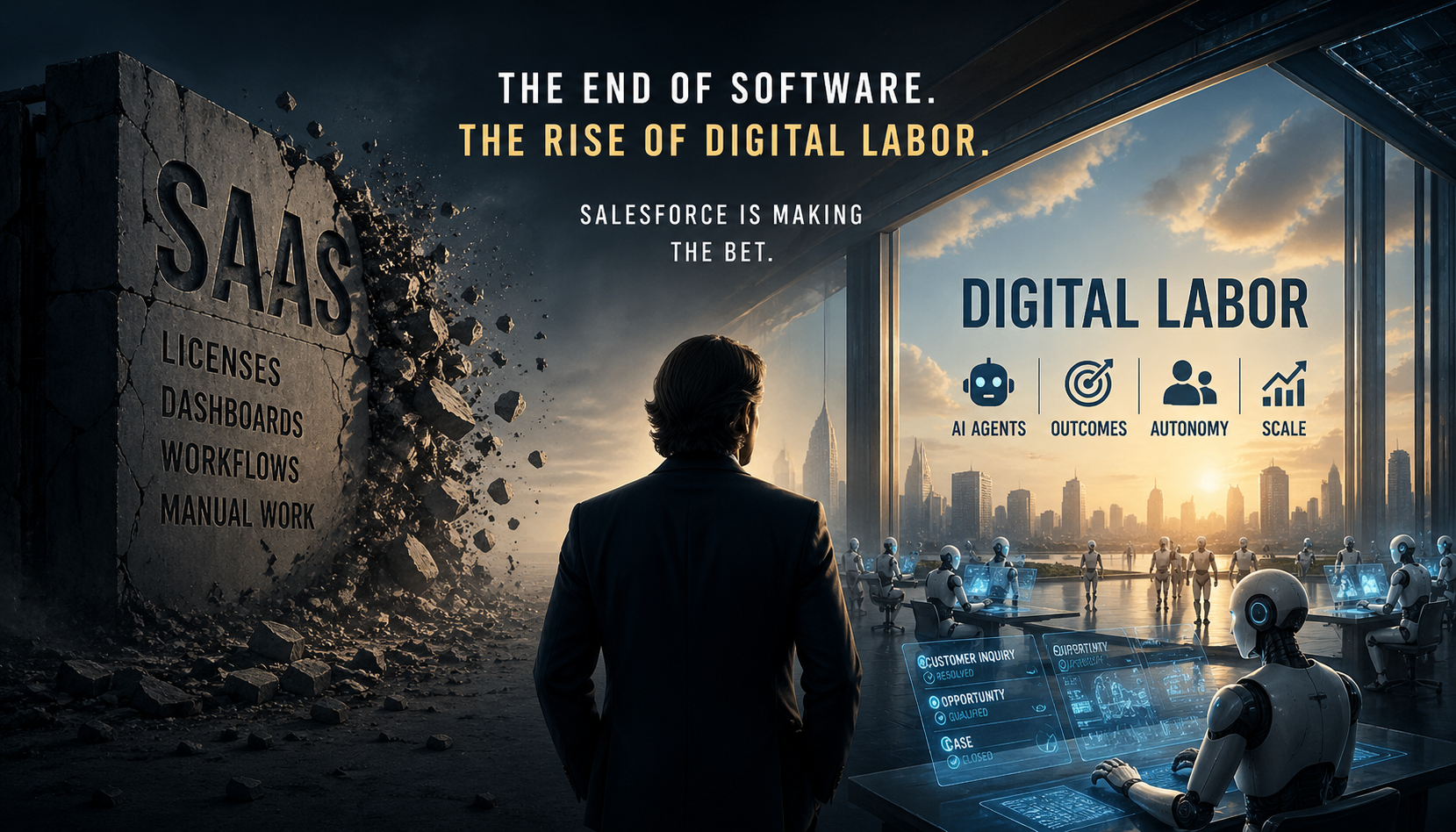
Marc Benioff is dismantling the abstraction that built Salesforce. The question is not whether he's right that software is becoming labor. It's whether the company that defined the seat can also define what replaces it.
In every technology cycle, there's a moment when the founder who built the dominant abstraction realizes that abstraction is about to become a liability. For Marc Benioff, that moment is now — and unlike most incumbents in that position, he is not pretending it isn't happening.
The clearest signal came on the Q4 FY25 earnings call in February 2025, when Benioff told investors that Salesforce's mission is to be "the No. 1 digital labor provider, period," and added: "We are the last generation to manage only humans." Read in isolation, that sounds like the kind of category-redefinition language CEOs have been workshopping since GPT-4 shipped. Read against what Salesforce is actually doing inside its own walls — cutting customer support headcount from 9,000 to roughly 5,000 over the course of 2025, automating between 30% and 50% of internal work, and pushing Agentforce as the strategic center of every earnings call — it is something stranger and more consequential. Benioff is not adding AI to SaaS. He is arguing that SaaS itself is the wrong frame for what enterprises will buy next.
That argument is the most important strategic bet in enterprise software right now, and it is being widely misread.
What Benioff is actually saying
The conventional read on Agentforce is that it is Salesforce's "copilot for CRM" — an AI layer bolted on top of the existing product. That read is wrong, and it matters that it is wrong, because the strategic logic only makes sense if you take Benioff at his word.
The original Salesforce abstraction was: we will manage your customer relationships better than you can. The product was a system of record with a user interface, and the buyer was the operations leader who needed her team to be more productive inside that interface. Every dollar of Salesforce revenue traced back to a seat — a human using the software.
The Agentforce abstraction is different in a way that breaks the seat model. It is: we will do the work, and you will supervise us doing it. The system of record is still there, but the user is no longer the operator. The agent is. The human becomes a reviewer, an exception-handler, a setter of policy. This is not a UX change. It is a change in who the customer is buying for. The buyer is no longer the operations leader staffing a team of users. It is the executive deciding how much of that team needs to exist.
That distinction is what makes the move a category pivot rather than a product update. Software-as-a-service priced per seat competes with other software. Digital-labor-as-a-service priced per outcome competes with payroll. The total addressable market is not 10x larger. It is in a different category of spend entirely. Benioff has been explicit about this in venue after venue — at Dreamforce, on podcasts, in interviews alongside Ray Dalio where he framed digital labor as "the 3 to 12 trillion dollar global shift" — and the consistency of the message across audiences is itself a tell. This is not earnings-call positioning. It is a story being told to remake a category.
The cost of this repositioning is also in a different category from a normal product launch. Salesforce has spent two decades building a sales motion, a partner ecosystem, and a pricing architecture around seats. All three are now in tension with the future the CEO is publicly committing to. This is what makes the move structurally unusual: most incumbents in Benioff's position protect the revenue model and let a startup eat the new category. He is doing the opposite, and doing it loudly. The most direct evidence is that Salesforce is willing to be customer zero for the cannibalization. The 4,000-role reduction in its own support organization, which Benioff disclosed on the Logan Bartlett podcast in September 2025 with the line "I've reduced it from 9,000 heads to about 5,000 because I need less heads," is not a side effect of efficiency gains. It is a public demonstration that the abstraction works on the company that sells it.
Where the bet is fragile
The vision is coherent. The execution is closing the gap, but it is not closed.
Salesforce ended FY25 (February 2025) with 5,000 Agentforce deals signed since the late-October launch — but only 3,000 of them paid. By Q3 FY26 (December 2025), the cumulative numbers had climbed to 18,500 deals and 9,500 paid, with paid deals up 50% quarter-over-quarter and Agentforce ARR crossing $500M, growing 330% year-over-year. Those are real numbers. They are also smaller than the rhetoric suggests. Salesforce has more than 150,000 customers. Even at 9,500 paid deals, the share of the installed base running paid Agentforce instances is in the single digits. The number of accounts in production — meaning actually using agents in live workflows, not just licensed — was disclosed as growing 70% quarter-over-quarter in Q3, which implies a base small enough that high growth rates remain easy. The product is real, but it is still a long way from being the default way customers use Salesforce.
This produces the gap that defines the bet. The narrative is running ahead of the product, and Benioff is betting that he can close the gap from both sides — making the product better while the market catches up to the framing — faster than a competitor can close it from a standing start.
There are two ways that bet loses.
The first is that the product never closes the gap at scale. Agentforce keeps growing impressively in percentage terms but stays a single-digit share of customer activity, the "digital labor" framing gets quietly walked back in 2027 earnings calls, and Salesforce ends up as a SaaS company that spent three years confusing its customers and its sales force. The cost of the confusion compounds: every quarter spent telling buyers that the seat model is dying is a quarter spent making the seat model harder to sell.
The second is more interesting. The product closes the gap, but the category Benioff defined — "digital labor" — gets won by someone else. The companies best positioned to sell labor are not necessarily the companies that sold software. They might be the workforce platforms, the BPO firms, the systems integrators, or a generation of AI-native startups that never carried Salesforce's installed base as ballast. In that scenario, Benioff is right about the future and still loses, because being early to a category does not guarantee owning it. Xerox was early to the GUI.
The bet only works if both halves resolve: the product matures, and the company that sold yesterday's seats becomes the company that sells tomorrow's outcomes. There is precedent for incumbents pulling this off — Microsoft's cloud transition is the obvious one — but the precedent is thin, and Microsoft had advantages of scale and capital that Salesforce does not.
What this means for the next 24 months
Three things follow from taking Benioff's bet seriously, whether or not it ultimately works.
The unit of enterprise software is changing, and the pricing has not caught up. Per-seat pricing assumes a human in the loop. Per-agent pricing assumes a unit of synthetic labor. Per-outcome pricing assumes a result. Each of these implies a different sales motion, a different procurement conversation, and a different definition of churn. The vendors that figure out the pricing first — not the technology first — will compound the fastest, because the pricing is what determines whether the buyer is the IT line or the workforce line. Benioff is betting on the workforce line. Most of his competitors are still selling to IT.
The interface is no longer the product, but the orchestration layer is. If agents do the work, the dashboard becomes a debugging tool, not a workplace. The thing the customer is actually buying is the layer that decides which agent runs, when, with what data, under what policy, and with what audit trail. This is the same insight the Klarna reversal forced on customer support — that the routing logic between agent and human is the actual product, not the agent itself. Salesforce is essentially betting that it can own that orchestration layer for the entire customer-facing function. If it can, the moat is enormous. If it can't, Agentforce is a feature, not a category.
The credibility cost of being early is asymmetric. If the product matures on schedule, Benioff looks prescient and Salesforce captures a category that didn't exist five years ago. If it doesn't, the company spends 2027 walking back the "digital labor" language the way Klarna walked back its 2024 chatbot announcement — except that Klarna's reversal was about a feature, and Salesforce's would be about an identity. That is a much harder rebuild. The first signs of strain are already visible. In August 2025, Benioff publicly dismissed predictions of AI-driven white-collar job losses; weeks later, he announced his own 4,000-role rebalance. The reconciliation — that the cuts were redeployment rather than displacement — may be technically accurate, but it is the kind of nuance that does not survive contact with a recession. Benioff's window to demonstrate scaled adoption — not pilots, not press releases, but a meaningful share of the installed base running agents in production — is roughly the next six quarters. After that, the narrative starts to age.
The bottom line
Benioff is not upgrading Salesforce. He is trying to make the version of Salesforce that exists today obsolete, on his own timeline, before a competitor or a customer does it for him. That is the rarest move an incumbent CEO can make, and it is almost always the right one — when it works.
The question is not whether he is right that software is becoming labor. He is. The question is whether the company that defined the seat can also define what replaces it, in the narrow window before the market decides the answer is somebody else.
There is no middle outcome. Either Salesforce becomes the operating system for the agentic enterprise, or it becomes the case study every business school uses to explain why incumbents shouldn't try.
That is what makes this the most interesting bet in enterprise software right now. Not the technology. The willingness to set fire to the abstraction that built the company, while the company is still standing on it.